Tuesday, March 9, 2010

Jack "The King of Comics" Kirby's costume designs

Thanks to Cambone on www.poe-news.com for pointing this out...

If you're reading a blog called "Culture High, Culture Low" (and let's be honest, you probably aren't), you hopefully share some of my interest in a wide range of artistic output.  I don't really think there's a hard line dividing "high" and "low," and even if there is, I think it's really limiting to focus on one or the other.  I'm a fan of ultra-cerebral modern and contemporary art as well as visceral pop culture like pop music, pro wrestling and, of course, comic books

I'm also a big fan of artists working across the traditional lines of "high/low" culture and/or combining more than one form of art.  A great example of this would be these costume designs for a 1969 production of Shakespeare's Julius Caesar, created by Jack Kirby, who is widely considered to be the most important and influential comic-book illustrator of the past 50 years at least.

The designs are classic Kirby, and are really only missing extreme foreshortening and some "Kirby Crackle" to complete the effect.

 Caesar in military garb, looking a lot like one of Kirby's "New Gods"

Roman field soldier - dig that stylized camouflage pattern!

Various Roman citizenry, including a fantastic Soothsayer

A very, VERY Kirby-looking Calpurnia

Calpurnia and the Maid give you a sense of how the designs translated into actual costumes.

Like a lot of comic fans of my generation (I first started reading them in the late 70s and it wasn't til the mid-80s that I became a full-on Comic Geek), my appreciation of Kirby was slow to build.  I respected his contributions to comic history, but didn't see the majesty in his artwork until I was in my 20s.  At that point, though, I completely fell in love with his costume designs, his dynamic page compositions, and the over-the-top mannerisms of his characters.  

It's not for nothing that the easiest way for any contemporary comic artist to make a comic look like it was published in the sixties is to ape Kirby.  Heck, it's still common for Marvel and DC to create blatantly Kirby-styled costumes for new massively-powered characters from deep space, or from godly realms like Asgard or Olympus.  Essentially, the Jack Kirby costume aesthetic is shorthand for "major player" in comics, sixteen years after his death.

Much more information on this project (including many more drawings, several photos and the play's program) and many other aspects of Kirby's incredible contributions to popular culture can be found at The Kirby Museum...

Tuesday, March 2, 2010

Fantastic diagram of Crayola color history


There's a symposium that I either just missed or am about to miss (I just can't afford the ticket or time this semester) hosted by Edward R. Tufte, the author of the classic design book The Visual Display of Quantitative Information.  I'm a big fan of the book, and once I've got a bit more free time (read: once I'm certified and have a teaching gig), I fully intend to get the follow-up books.

Here's an example of the sort of thing Tufte talks about:


This diagram of the history of available colors in Crayola crayons just sets my left brain a-hummin'!

It's particularly interesting to look at the increased range of "skintone" colors in the late 50s...and also worth noting that the color "flesh" was renamed to "peach" in 1962.  Nowadays, you can get a pack of various pinks, beiges and browns that can be used as skintones, but thankfully none of them is called "flesh," as that would pretty blatantly tell kids that that one color was the "right" color for skin.

Monday, March 1, 2010

Tuesday, February 23, 2010

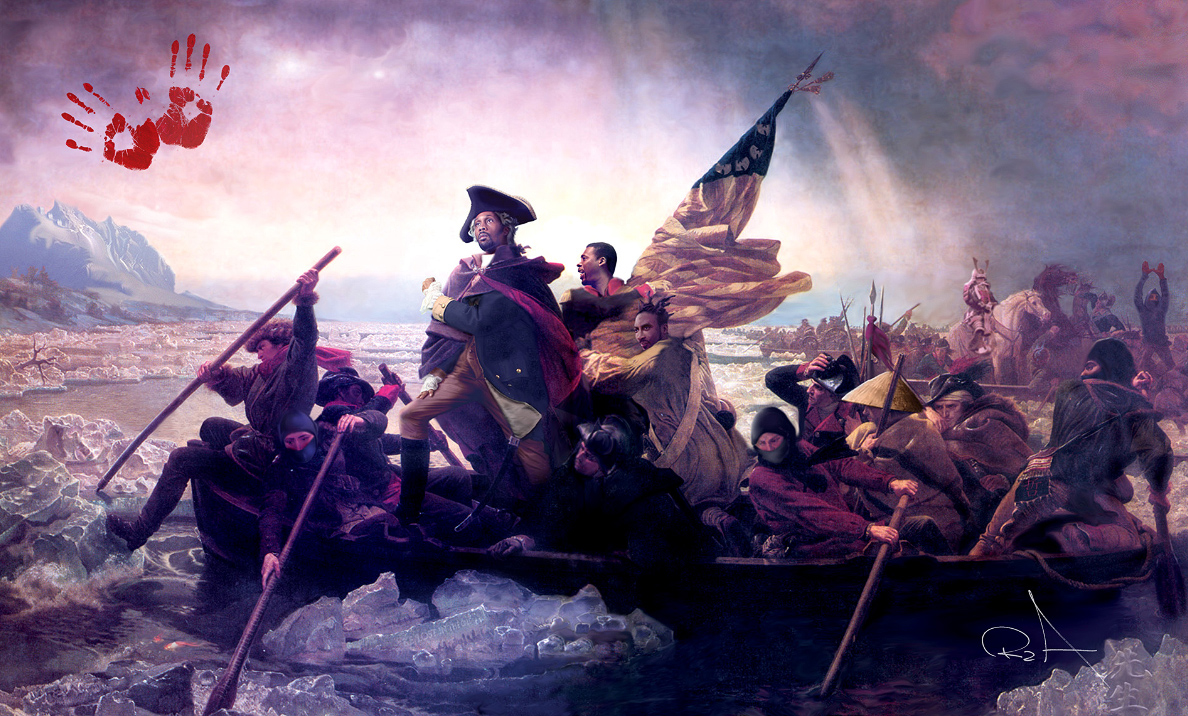
RZA Crossing the Delaware (or "how to introduce irony to high-schoolers")

Irony is an unavoidable subject in discussion of contemporary art, but at times it's hard to explain to high schoolers in terms that they understand. My students so far have tended to love Warhol, Basquiat and Murakami, but they often don't recognize the references to art history that those artists made in much of their work. As such, an important aspect of the artists and their work is overlooked.  Art teachers often just don't have the time to give full art-historical context to individual images they show their students.

Warhol's Gold Marilyn comes off as a lot gutsier when students know a little about Byzantine icons.

This isn't to say that students must have a full Janson's-textbook-worth of art historical knowledge to be able to appreciate irony and recontextualization in contemporary art.  Kehinde Wiley's portraits of African-American youth in heroic poses, subvert Western tradition of representation in a way that's clear enough to adolescents.  A teenager doesn't necessarily need to know about Salon painting to know that it's atypical for African-American youth to be represented on a field of fluer de lis.  

Still, though - it's been over a decade since mainstream hip hop became the glammy, fashion-conscious, ultraconsumerist pop culture that it is now.
 
This image of Biggie Smalls is so glammy!  That's completely out of character for hip hop...


 Oh, wait.

As someone whose goal is to teach art history and studio art to high schoolers and/or middle schoolers, I try to keep an eye out for images of contemporary art that straddle the "high and low" divide, that use imagery so well-known to adolescents that the irony of their appropriation would be clear to everyone without needing to go back and explain what artwork the contemporary artist was riffing off of. 

I've recently found a great example, which was posted online about a month and a half ago:

It's safe to assume that, at the very least, students have seen the Emanuel Leutze painting Washington Crossing the Delaware (1851) in a social studies textbook.  They've probably seen it parodied in old Bugs Bunny cartoons.  It's an ubiquitous piece of American culture.

And now it's been appropriated by the art collective When Art Imitates Life:


Yes, that IS the Wu-Tang Clan crossing the Delaware River, with ninja manning the oars.

(for a bigger version, click here. )

This image is ridiculous.  And it's awesome.  It would be instantly recognized as the parody/appropriation/recontextualization/self-aggrandizement that it is, and could be used as a really great starting point for a discussion of other ironic appropriation of older forms (like Warhol and Wiley), or a discussion about how heroes are presented, or even about who gets to be called a hero.  

My only concern is whether adolescent students consider Wu-Tang to be at all relevant anymore.  These kids today, with their hippin' and their hoppin', they don't understand the classics like "Protect Yo' Neck."

Tuesday, February 16, 2010

Don't underestimate elementary-school art students!


(click the image to see it in a more legible size)

Behold: the patron saints of snarky pop-culture-critic bloggers


...as well as an early-ish example of a pop culture product beating its detractors to the punch.

Monday, January 18, 2010

"Every text creates its reader" - Umberto Eco


I haven't seen Avatar yet (movies just aren't worth paying a babysitter to take care of a toddler), but am marvelling at the inevitable "otherkin" reactions to the film.  Some people online are claiming that they are (spiritually and metaphysically) Na'vi, the computer-animated furry amalgam of Native American and Southeast Asian stereotypes presented as the "noble savage" in the movie.  There's even someone who's trying to create a "new Native American tribe" based on the Na'vi in Florida.

I've always been interested in personal statements from the insane and delusional, and over the last decade-and-change of access to the internet have found a lot of hilarious examples of group psychology, body dysmorphism and internet anonymity combining to create groups of people whose commonality is that they are all secretly something better than human - be it elves, dragons, mystical hermaphroditic foxes with butterfly wings, or now Na'vi.

What's greatest about watching this new group of "otherkin" emerge is that they're getting no love from the people who get together online to discuss how they're all elves or vampires or whathaveyou.  Because, you see, Na'vi are fictional

If this causes a huge internet meltdown with cries of 'persecution' and offensive attempts at identity politics which coopt the legitimate claims and identities of real-world minority groups, I will take back everything bad I've said about James Cameron since halfway through The Abyss.